Synopsis
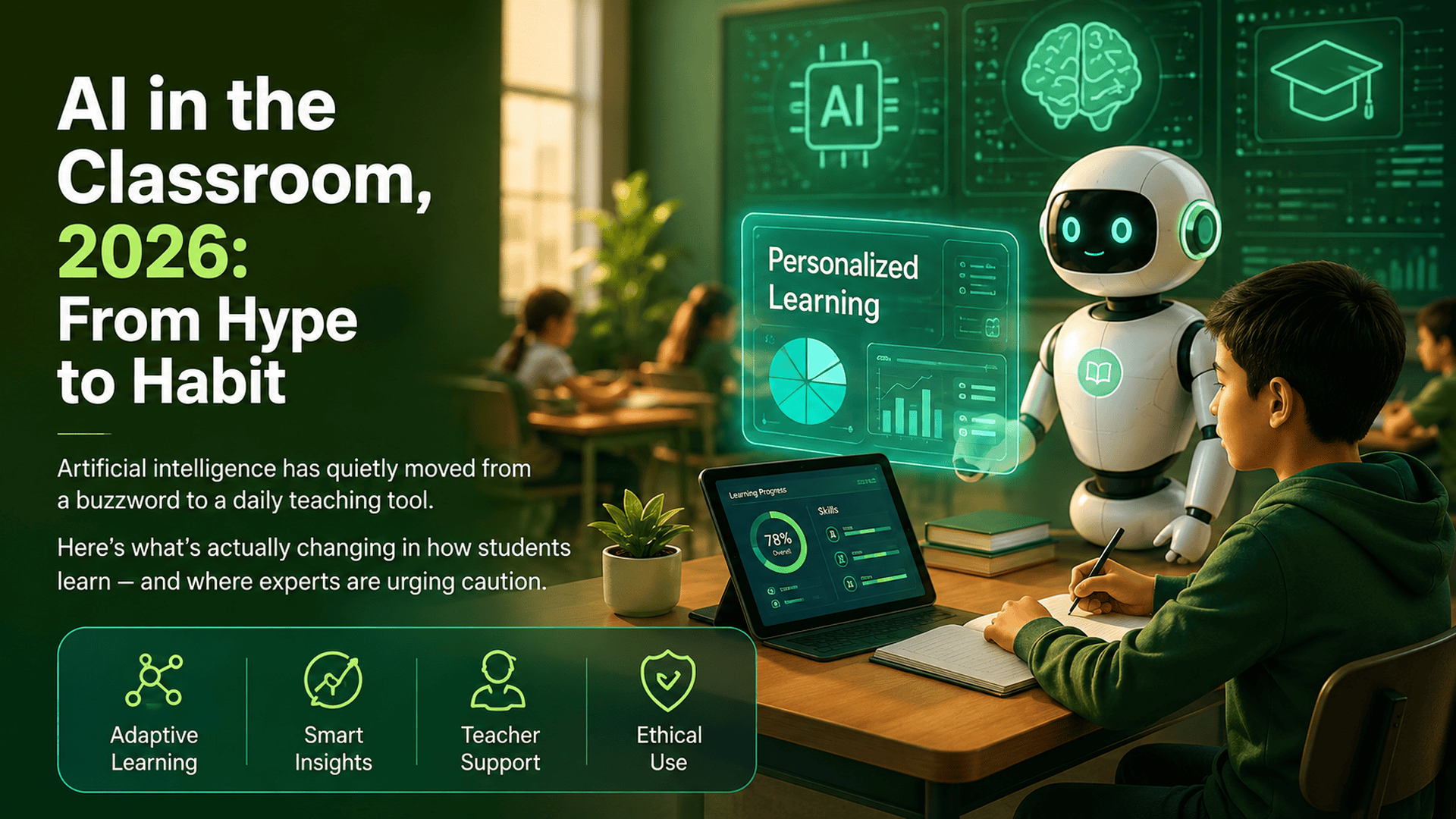
Artificial intelligence has quietly moved from a buzzword to a daily teaching tool. Here's what's actually changing in how students learn — and where experts are urging caution.
Content Body
For the last few years, "AI in education" has mostly meant pilot projects and press releases. In 2026, that's shifting. Institutions are moving past broad promises of "personalization for everyone" and focusing on narrower, provable wins: AI helping teachers plan lessons faster, automating routine admin work, and giving students real-time feedback instead of waiting days for a graded assignment back.
The scale of this shift is hard to ignore. Industry estimates put the global AI-in-education market at roughly $7.5 billion in 2025, with projections of it multiplying many times over by the mid-2030s as more schools, universities, and edtech platforms build AI directly into their core tools rather than treating it as an add-on. Surveys of educators reflect the same trend on the ground — a majority now report using AI tools in their teaching routines, and many say it has freed up time to spend with students directly rather than on paperwork.
What does this look like in practice? Adaptive tutoring systems that adjust difficulty in real time based on how a student is doing. Instant, specific feedback on writing and problem-solving instead of generic marks. Reduced grading and scheduling load for teachers, who report it easing burnout in a profession that has struggled with staffing shortages. In under-resourced schools and developing regions, AI-driven platforms are increasingly used to deliver personalized instruction — in language learning, for example — to students who otherwise wouldn't have access to one-on-one support.
But 2026 has also brought a more sober, second-wave conversation. Global surveys of university faculty show a mixed picture: while interest in using AI for teaching remains strong in many regions, some — notably North America — have actually seen a decline in faculty intent to use it, a signal that early enthusiasm is being tempered by real classroom experience. Education bodies internationally are pushing institutions to move from general-purpose AI chatbots toward tools built specifically for learning outcomes, not just faster task completion. There's particular concern about what's being called the "illusion of learning" — students who lean on AI so heavily for answers that their own critical thinking and ability to self-check their work quietly erodes underneath the surface of good grades.
There's also a trust gap worth naming. Recent research suggests a large share of students don't feel their assessments actually reflect the skills they'll need in an AI-shaped workplace — and a similarly large share worry that classmates are using AI to gain an unfair edge on graded work. That tension between AI as a learning accelerator and AI as a shortcut is likely to define education conversations for the next few years, not just this one.
For learners on a platform like ours, the practical takeaway is simple: AI-supported learning works best as a tutor, not a substitute for doing the thinking yourself. Use it to get unstuck, to get explanations in a different way when the first one doesn't click, and to practice more — not to skip the practice altogether.
Conclusion
AI in education isn't a future trend to wait out — it's already reshaping how lessons are taught, how feedback is given, and how fast students can learn. The advantage will go to learners who use it deliberately, as a tool that sharpens their own thinking rather than one that quietly replaces it.
Open a New Door with Ekluvya by which your child gets:
- All grades (Nursery - 12) and IIT/NEET foundation courses
- The power to choose a teacher, by topic
- Online flexibility and Netflix-like quality