Introduction
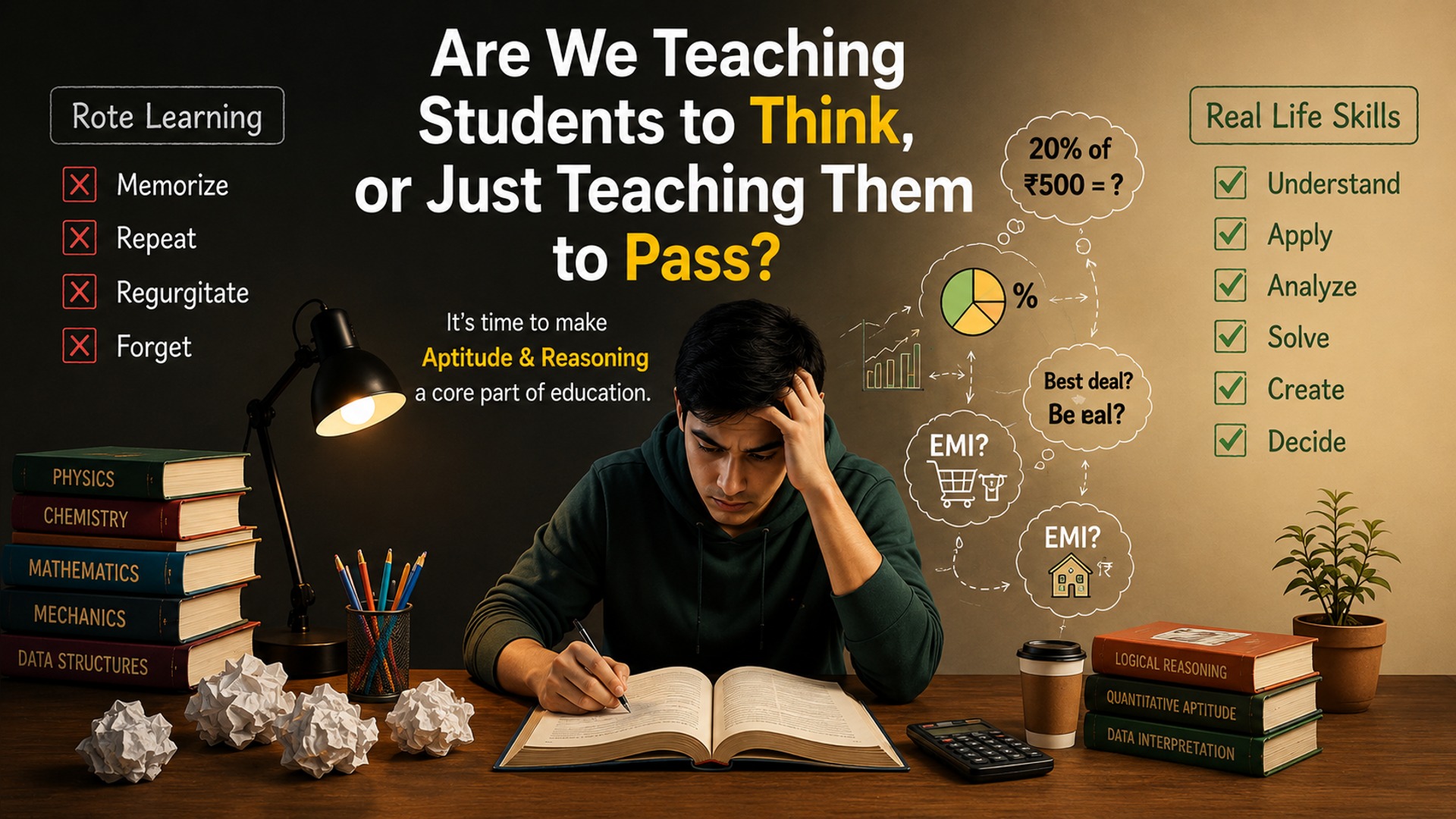
We celebrate marks. We celebrate ranks. We celebrate exam scores. But are we celebrating thinking?
A student can spend more than a decade in school, followed by years in college, and still struggle with surprisingly simple questions:
- What is 20% of ₹500?
- Which is a better discount?
- How much interest will I actually pay on a loan?
- Can I estimate whether this bill is correct?
- What does this graph actually tell me?
- How do I break a complicated problem into smaller, manageable parts?
These aren't merely mathematics questions. They are life skills. And that raises an uncomfortable question: Are we teaching students to pass exams, or are we teaching them to think?
The Gap Is Not Intelligence. The Gap Is Training.
Our education system teaches students a tremendous amount of information. Students learn mathematics, physics, chemistry, biology, engineering and countless other subjects. They solve equations, memorize formulas and prepare for examinations.
Yet many students don't get enough opportunities to develop the ability to apply what they know.
- A student may be able to solve a complex mathematical problem on paper but hesitate when calculating a percentage in a real-life situation.
- They may remember dozens of formulas but struggle with an unfamiliar problem where there is no obvious formula to apply.
- They may score well in an examination but find it difficult to interpret a graph, compare two financial options or estimate whether an answer makes sense.
The problem isn't that students aren't intelligent. The problem is that thinking is a skill, and skills need to be deliberately developed.
Aptitude Shouldn't Begin with Placement Preparation
For many students, the word "aptitude" becomes familiar only when they start preparing for:
- College entrance examinations
- Campus placements
- CAT and other competitive examinations
- Government examinations
- Interviews
- Recruitment tests
By then, students are often learning aptitude as something they need to clear a test. But aptitude is much bigger than that.
Percentage, ratio, estimation, probability, logical reasoning, pattern recognition, data interpretation and mental calculation are useful far beyond an examination hall. They influence how we understand salaries, discounts, loans, investments, bills, statistics, business decisions and everyday choices. So why shouldn't students start developing these abilities much earlier?
Imagine If Aptitude and Reasoning Were a Core Skill
Imagine a subject called Applied Reasoning & Quantitative Thinking. Instead of simply memorizing formulas, students could learn how numbers and logic work in everyday life.
- Numerical thinking — percentages, ratios, averages, estimation, probability, interest and financial calculations.
- Logical thinking — patterns, sequences, deduction, classification, cause and effect and structured reasoning.
- Problem-solving — how to understand a problem, identify relevant information, break it into smaller parts and choose an appropriate approach.
- Mental agility — mental mathematics, approximation, quick comparisons, memory and concentration.
- Real-world decision making — comparing prices, understanding loans, analysing data, planning budgets and evaluating choices.
The objective wouldn't be to make every child a mathematician. The objective would be to help every child become more comfortable with thinking.
Fast Calculation Is Only One Part of the Story
Mental math is often associated with speed. But speed isn't the ultimate goal. The real benefit is number sense.
When students regularly work with numbers mentally, they begin to develop an intuition for whether an answer makes sense. For example, if a product costs ₹800 and someone says a 25% discount makes the price ₹700, a student with strong number sense can immediately recognize that something is wrong. That confidence comes from understanding numbers rather than simply remembering a formula.
The same principle applies to reasoning. The goal isn't merely to solve puzzles quickly. It is to develop the habit of asking:
- What information do I have?
- What information matters?
- What is the relationship between these things?
- What assumptions am I making?
- Does my answer actually make sense?
Those are powerful questions in education, careers and everyday life.
It Starts at Home Too
Education doesn't happen only inside classrooms. Children observe how adults make decisions, solve problems, manage money, react to mistakes and approach unfamiliar situations.
This raises another important question. If many adults themselves were never explicitly taught practical reasoning, how can we expect every parent to consciously develop those skills in their children? This isn't about blaming parents. Parents are products of the same education system.
Most of us were taught what we needed to pass our examinations. We weren't necessarily taught how to systematically develop reasoning, decision-making and problem-solving as lifelong skills. That's why this needs to become a collective educational priority.
We need to create an environment where children are encouraged to ask:
- "Why?"
- "How?"
- "What if?"
rather than simply: "What is the answer?"
What Should Education Do Differently?
We don't necessarily need another textbook. We need a different way of learning.
- Start developing these skills from an early age.
- Move from simple concepts to increasingly complex problems.
- Use real-world situations instead of only abstract questions.
- Combine mental math with logical reasoning.
- Encourage estimation before calculation.
- Use puzzles, games and challenges to make practice engaging.
- Reward the process of thinking, not just the final answer.
- Allow students to learn from mistakes.
- Gradually increase speed without sacrificing understanding.
Most importantly, students should experience why these skills matter. A percentage question becomes more meaningful when it is connected to a shopping discount. A ratio question becomes more meaningful when it involves a recipe or sports statistics. A probability question becomes more meaningful when students can see it through a game. A data interpretation problem becomes more meaningful when it involves information they encounter in real life.
Learning becomes stronger when students can connect knowledge to the world around them.
Technology Can Change How We Practice Thinking
This is where modern education technology has an important role to play. Aptitude doesn't have to mean sitting with a book and solving hundreds of repetitive questions. Students can practice through interactive challenges, games, simulations, adaptive difficulty and real-life scenarios.
A system can start with a simple percentage problem and gradually increase the difficulty based on how the student performs. It can identify whether a student is struggling with calculation, comprehension, reasoning or decision-making. Instead of simply saying "Wrong answer," learning technology can help students understand why their approach didn't work. That changes practice from repetition into development.
The Future Student Needs More Than Knowledge
The world is changing quickly. Students will have access to more information than any previous generation. Artificial intelligence can already retrieve information, calculate numbers and explain concepts within seconds. That makes one human ability even more important: Knowing how to think.
Students need to know how to question information, identify patterns, evaluate choices, recognize unreasonable answers, solve unfamiliar problems and make decisions when there isn't a textbook answer. Knowledge will remain important. But the ability to use knowledge intelligently will become even more valuable.
At Ekluvya, We Believe Learning Should Develop the Mind
Education shouldn't be limited to completing a syllabus or scoring marks. The ultimate goal of learning should be to help students become more capable of understanding the world around them.
That means developing curiosity. Building confidence. Strengthening reasoning. Improving problem-solving. And helping students become comfortable with challenges they have never seen before.
- We shouldn't wait until a student reaches college placement season to ask whether they can think logically.
- We shouldn't wait until an entrance examination to discover whether they understand basic quantitative concepts.
- And we shouldn't teach children only how to find the correct answer.
We should teach them how to find their way to the answer. Because education isn't just about preparing students for the next examination. It is about preparing them for life.
Let's not just teach students to pass. Let's teach them to think.
Open a New Door with Ekluvya by which your child gets:
- All grades (Nursery - 12) and IIT/NEET foundation courses
- The power to choose a teacher, by topic
- Online flexibility and Netflix-like quality