Introduction
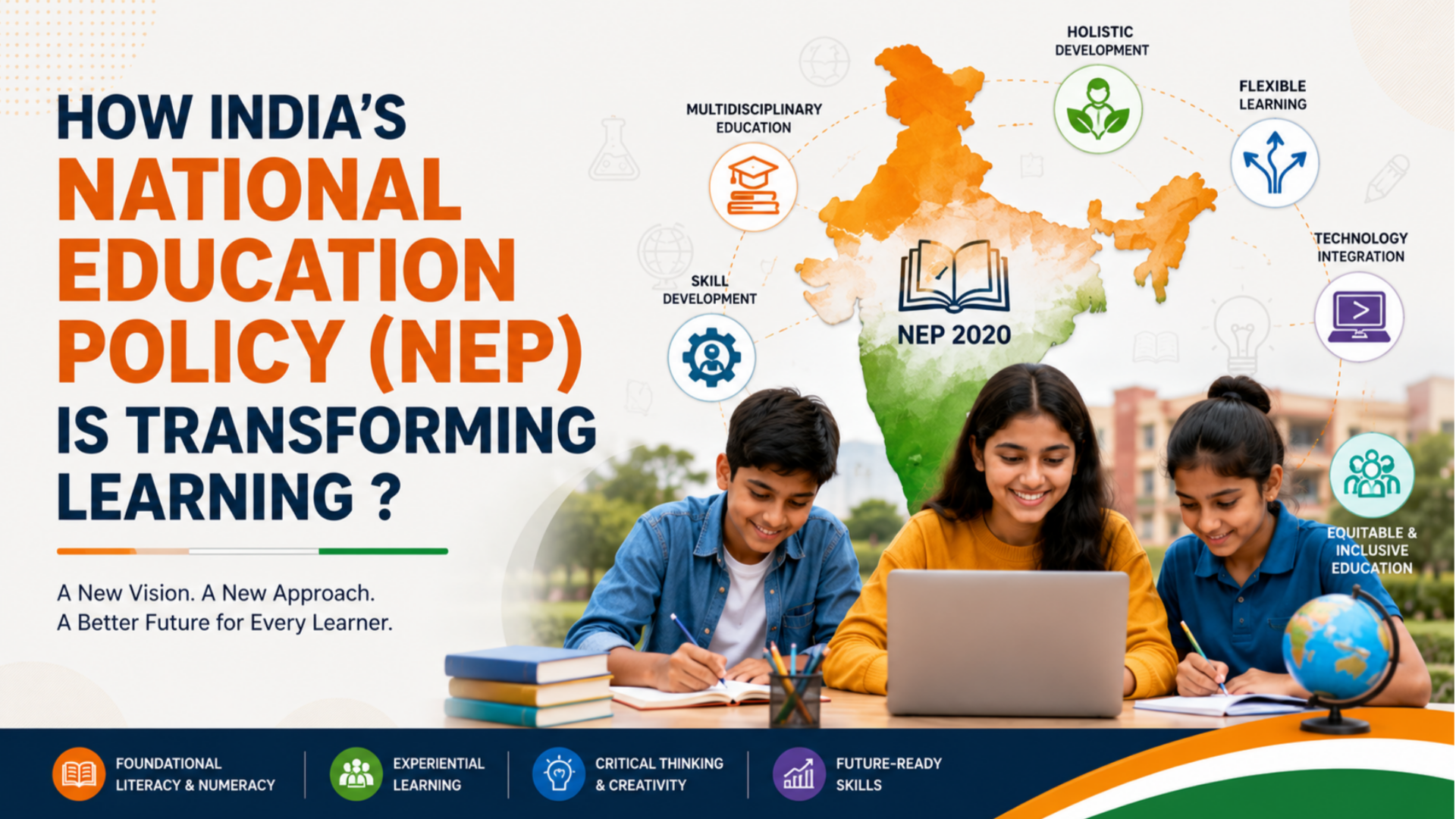
Education has always been the foundation of a nation's progress. As societies evolve and industries become increasingly driven by technology, the education system must adapt to prepare learners for the future. Recognizing this need, the Government of India introduced the National Education Policy (NEP) 2020, marking one of the most significant educational reforms in decades.
The National Education Policy aims to reshape the Indian education system by moving beyond traditional rote learning and fostering creativity, innovation, critical thinking, skill development, and holistic growth. It seeks to create an education ecosystem that is inclusive, flexible, technology-enabled, and globally competitive.
For students, educators, parents, and educational technology platforms like Ekluvya, NEP represents a transformative opportunity to redefine how learning is delivered and experienced.
This article explores how India's National Education Policy is transforming learning, the key reforms introduced under NEP 2020, its impact on learners and educators, and what the future of education in India may look like.
Understanding the National Education Policy (NEP)
The National Education Policy 2020 replaced the previous education policy introduced in 1986. It was developed after extensive consultations with educators, researchers, policymakers, industry experts, and citizens across the country.
The policy has a long-term vision of making India a global knowledge superpower while ensuring that every learner has access to quality education regardless of location, language, or socioeconomic background.
Rather than focusing only on academic achievement, NEP emphasizes developing well-rounded individuals equipped with practical skills, creativity, ethical values, and lifelong learning abilities.
Why India Needed Educational Reform
For many years, India's education system primarily emphasized examination scores, memorization, and standardized learning methods. While this approach produced academically strong graduates, it often left students underprepared for rapidly changing industries.
Several challenges highlighted the need for reform:
- Heavy dependence on rote learning
- Limited focus on practical applications
- Increasing skill gaps between education and employment
- Lack of flexibility in choosing subjects
- Insufficient emphasis on creativity and innovation
- Unequal access to quality education
- Growing demand for digital learning
The National Education Policy addresses these issues by creating a learner-centric education model.
Key Features of NEP 2020
1. A New School Structure: 5+3+3+4
One of the most significant reforms is replacing the traditional 10+2 structure with the 5+3+3+4 model.
The structure is divided into four stages:
Foundational Stage (5 Years)
- Early childhood education
- Activity-based learning
- Language development
- Numeracy and literacy
Preparatory Stage (3 Years)
- Interactive classroom learning
- Exploration and discovery
- Foundational science and mathematics
Middle Stage (3 Years)
- Experiential learning
- Coding introduction
- Critical thinking
- Project-based education
Secondary Stage (4 Years)
- Flexible subject selection
- Multidisciplinary education
- Career-oriented learning
- Research and innovation
This framework aligns education with children's cognitive development rather than age alone.
Moving Beyond Rote Learning
One of the biggest transformations introduced by NEP is shifting from memorization to conceptual understanding.
Students are encouraged to:
- Ask questions
- Solve real-world problems
- Participate in discussions
- Conduct research
- Build projects
- Apply knowledge practically
Instead of simply remembering textbook answers, learners develop analytical and decision-making skills that prepare them for higher education and professional careers.
Flexible Subject Choices
Traditional education often divided students into Science, Commerce, or Arts streams. NEP removes these rigid boundaries. Students can now combine subjects according to their interests.
For example, a student may study:
- Physics
- Economics
- Music
- Artificial Intelligence
- Graphic Design
This multidisciplinary approach encourages innovation and allows learners to build unique career paths.
Holistic Development and Life Skills
NEP goes beyond academics and emphasizes the overall development of students. It recognizes that education should nurture mental, physical, and emotional well-being.
The policy encourages:
- Sports and physical education
- Arts and creative expression
- Ethical and moral values
- Social responsibility
- Critical thinking and problem-solving
- Emotional intelligence
This approach ensures that students grow into well-rounded individuals capable of contributing meaningfully to society.
Technology as a Learning Partner
Technology is central to NEP's vision. Digital learning platforms are becoming increasingly important in supporting classroom education.
Modern educational platforms provide:
- On-demand video learning
- Interactive quizzes
- Live online classes
- Personalized recommendations
- Progress tracking
- Virtual laboratories
- Smart assessments
Platforms like Ekluvya enable learners to continue learning anytime, anywhere, making education more flexible and accessible. Technology also allows teachers to monitor student performance and provide personalized support.
Learning in Regional Languages
Language plays a crucial role in education. NEP recommends that wherever possible, foundational education should be delivered in the learner's mother tongue or regional language.
Research consistently shows that children learn concepts more effectively when taught in a familiar language during their early years. This approach strengthens conceptual understanding while preserving India's rich linguistic diversity.
Skill Development for Future Careers
Today's employers value skills as much as academic qualifications. NEP encourages schools and colleges to introduce vocational education from an early stage.
Students gain exposure to fields such as:
- Robotics
- Artificial Intelligence
- Coding
- Entrepreneurship
- Agriculture
- Electronics
- Design
- Financial literacy
- Communication skills
This ensures learners are better prepared for future careers and evolving industries.
Experiential Learning
Rather than relying solely on textbooks, NEP encourages experiential learning through:
- Science experiments
- Field visits
- Group discussions
- Project work
- Simulations
- Internships
- Community engagement
These experiences help students understand concepts more deeply while improving teamwork and communication.
Continuous Assessment Instead of Exam Pressure
Traditional education often depended on one final examination. NEP promotes continuous assessment that evaluates:
- Classroom participation
- Practical work
- Assignments
- Creativity
- Projects
- Problem-solving
- Communication skills
This reduces examination stress and provides a more comprehensive picture of student learning.
The Growing Role of Educational OTT Platforms
Educational OTT platforms are becoming an essential part of India's learning ecosystem. Unlike traditional classrooms, OTT learning platforms offer flexibility and convenience.
Students can:
- Learn at their own pace
- Pause and revisit lessons
- Access expert educators
- Watch lessons on multiple devices
- Study during travel
- Continue learning after school hours
These advantages make OTT education particularly valuable for working professionals, competitive exam aspirants, and learners in remote areas. Platforms like Ekluvya are helping bridge educational gaps by making quality learning content available to a broader audience.
Empowering Teachers
NEP recognizes that teachers remain at the heart of quality education. The policy emphasizes:
- Continuous professional development
- Digital teaching skills
- Modern pedagogical methods
- Improved teacher training
- Greater academic freedom
Technology is intended to support teachers—not replace them. Digital tools reduce administrative work, allowing educators to focus more on teaching and mentoring students.
Higher Education Reforms
The National Education Policy also introduces significant reforms in higher education. These include:
- Multiple entry and exit options
- Academic Credit Bank
- Flexible degree programs
- Multidisciplinary universities
- Research-focused education
- International collaboration
Students now have greater flexibility in planning their academic journeys without losing previously earned credits.
Challenges in Implementing NEP
While the policy presents an ambitious vision, implementation remains a gradual process. Some of the challenges include:
- Digital infrastructure gaps
- Teacher training requirements
- Rural internet connectivity
- Institutional readiness
- Funding and resource allocation
- Curriculum redesign
- Assessment reforms
Successful implementation requires collaboration among governments, schools, universities, technology providers, educators, parents, and learners.
The Future of Education in India
India is entering a new era of education. Future classrooms are expected to integrate:
- Artificial Intelligence tutors
- Virtual Reality learning
- Adaptive assessments
- Personalized learning pathways
- Learning analytics
- Interactive digital content
- Smart classrooms
- Educational OTT platforms
Education will increasingly become learner-driven rather than institution-driven. Students will continuously acquire new skills throughout their careers instead of stopping after graduation.
How Ekluvya Supports the Vision of NEP
At Ekluvya, we believe learning should be accessible, engaging, and future-ready. Our platform aligns closely with the objectives of the National Education Policy by offering:
- Flexible, on-demand learning experiences
- Expert-led educational content
- Multi-device accessibility
- Technology-enabled education
- Interactive learning journeys
- Continuous skill development
- Personalized learning experiences
As education evolves, Ekluvya aims to empower learners with knowledge that goes beyond textbooks and prepares them for the challenges of tomorrow.
Open a New Door with Ekluvya by which your child gets:
- All grades (Nursery - 12) and IIT/NEET foundation courses
- The power to choose a teacher, by topic
- Online flexibility and Netflix-like quality
Conclusion
The National Education Policy 2020 represents far more than a curriculum update—it is a transformative vision for India's future. By emphasizing critical thinking, flexibility, skill development, technology integration, multilingual education, and holistic growth, NEP seeks to prepare learners for a rapidly changing world.
Its success will depend on thoughtful implementation, collaboration across stakeholders, and continued investment in teachers, infrastructure, and digital innovation. Educational technology platforms have an important role to play by extending access to quality learning beyond traditional classrooms.
For millions of learners across India, NEP opens the door to an education system that values curiosity over memorization, understanding over repetition, and lifelong learning over one-time qualifications. As this transformation continues, the combination of progressive policies and innovative digital platforms will help shape a generation that is more skilled, adaptable, and ready to contribute to India's growth on the global stage.
Education is no longer just about earning a degree—it's about developing the knowledge, skills, and mindset needed to thrive in the future. The National Education Policy is laying that foundation, and the journey has only just begun.