Introduction
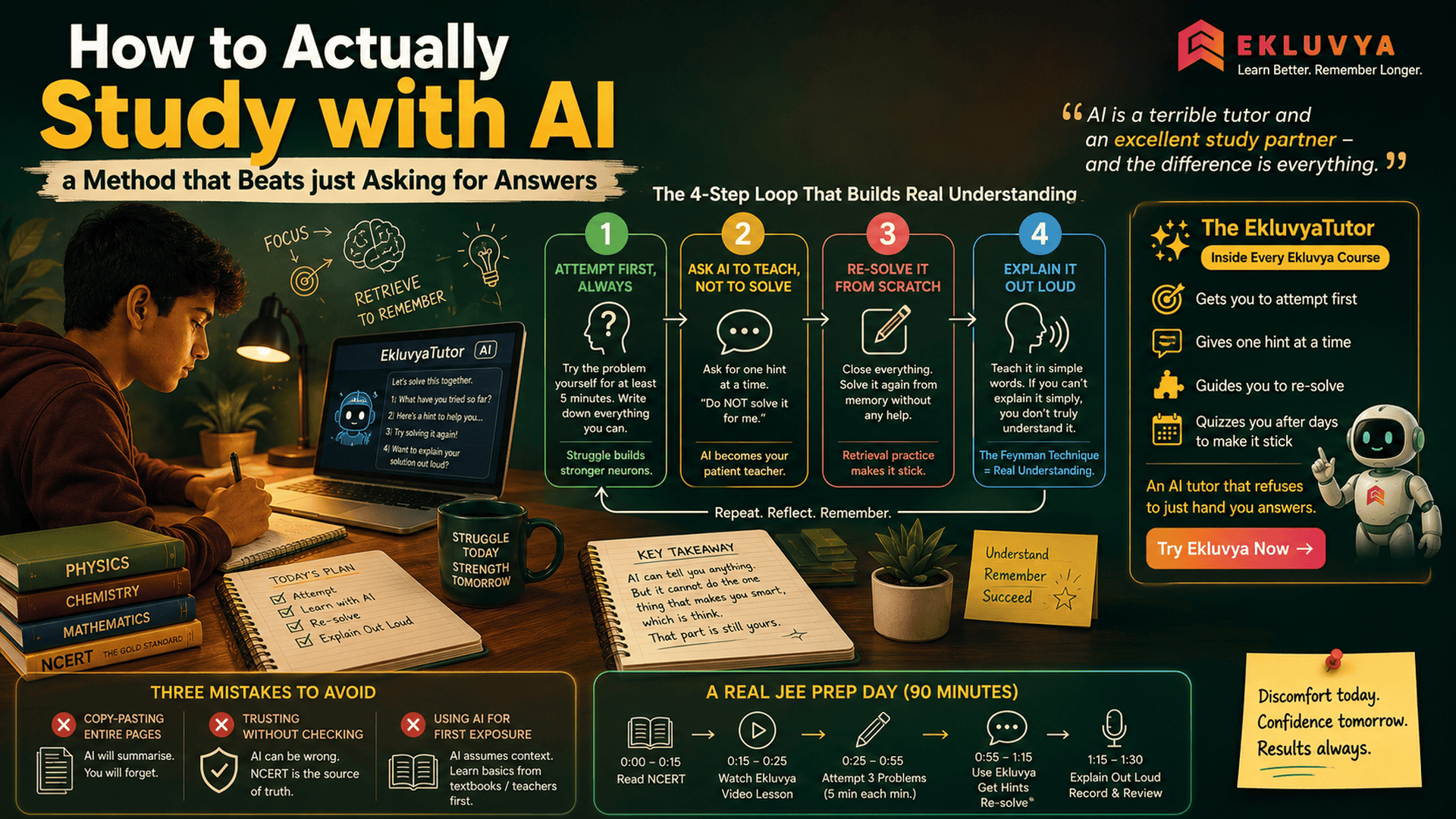
Most students use AI like a homework vending machine. That's why it doesn't work. Here's the 4-step loop that turns AI from a shortcut into a study partner - and helps you remember what you learn long after the exam.
Here's something most students figure out too late: AI is a terrible tutor and an excellent study partner - and the difference is everything.
Last month I sat with a Class 12 student preparing for JEE. She had been using ChatGPT for three months. Every time she got stuck on a Physics problem, she pasted it in, read the answer, nodded, and moved on. Her mock test scores hadn't improved. Her confidence was dropping. And she couldn't understand why - she was studying more than her friends.
The answer wasn't that AI was wrong. The AI was right, almost every time. The problem was that she was using it as an answer machine, and answer machines don't teach anyone anything.
This article is about the other way. A method - four steps, nothing fancy - that takes AI from shortcut to study partner. I've watched it work with dozens of students. It's the same loop we built into the Ekluvyatutor inside Ekluvya, and it's rooted in something called retrieval practice, which cognitive scientists have been shouting about for 40 years and students have been ignoring for just as long.
Why the "just ask AI" approach fails
When you read an AI-generated answer, your brain does a thing that feels like learning but isn't. It's called the illusion of fluency. You read a clean, well-structured explanation, and because it was easy to follow, your brain concludes: I understand this.
You don't. You recognise it. Those are different things. Recognition is cheap - your brain does it automatically when you see something familiar. Understanding is expensive - it requires you to construct the answer yourself, from memory, under the pressure of not being sure.
Recognition gets you through a chapter. Understanding gets you through an exam.
The whole point of a good study method is to force your brain to do the expensive thing. AI, used naively, lets you skip it.
If using AI makes your study session feel easier, you're probably learning less. The discomfort of trying-and-failing-and-trying-again is not a bug in studying. It's the feature.
The 4-step loop
Here's the method. It takes a little longer per problem than "just ask AI." Your retention will double or triple for the same hour of study. I'm not exaggerating - this is one of the best-documented findings in learning science.
Step 1: Attempt first, always
Before you open any AI, any textbook, any YouTube video - try to solve the problem yourself for at least 5 minutes. Even if you're stuck. Especially if you're stuck.
Write down whatever you can. The formula you think applies. The variables you can identify. The approach that feels wrong but is the only one you've got. This is called the struggle phase, and it's where learning actually happens. The neurons you're about to form grow in this phase. If you skip it, nothing grows.
Set a timer if you need to. 5 minutes minimum. No exceptions.
Step 2: Ask AI to teach, not to solve
This is the prompt that changes everything. Instead of:
Try:
The magic word is "do not solve it." AI will always default to giving you the full answer - it's what it's trained to do. You have to explicitly restrain it. When you do, something beautiful happens: AI becomes the world's most patient teacher, feeding you exactly one clue at a time, letting you do the work.
Step 3: Re-solve it from scratch
Once you've gotten through it with hints, close the AI window. Open a blank page. Solve the same problem again, from memory, without any help.
If you can't - go back, re-read your own working, close the page, try again. Repeat until you can solve it cold.
This is the retrieval practice part. Nothing else you do today will matter more than this step.
Step 4: Explain it out loud
This is the one students skip the most and regret the most. After you've re-solved the problem, explain your solution out loud - to a wall, to a sibling, to a recording app on your phone, doesn't matter. Say it in simple words.
If you can't explain it simply, you don't understand it. This is known as the Feynman technique, after the physicist Richard Feynman, and it's the single best test of real understanding anyone has ever invented.
When you stumble in your explanation - that's where your understanding is thin. Go back to the material for that specific part. Then explain it again.
How we built this into Ekluvya
An AI tutor that refuses to just hand you answers
Ekluvya- the AI tutor built into every Ekluvya course - is designed around this exact loop. Ask it a JEE Physics question and it asks you what you've tried first. It gives one hint at a time. It asks you to re-solve it. And it'll quiz you three days later to make sure it stuck. It's the tutor we wish we'd had.
Try Ekluvya Now →Three mistakes to avoid
Mistake 1: Copy-pasting screenshots of entire pages. AI will happily summarise an entire chapter for you. Then you'll read the summary, feel productive, and retain nothing. Always narrow the question. One concept at a time.
Mistake 2: Trusting without checking. AI is confidently wrong about things - especially Maths derivations and Chemistry mechanisms. If something smells off, it probably is. Check against your NCERT textbook. Always keep the textbook as the source of truth.
Mistake 3: Using AI for first exposure to a topic. AI is terrible at introducing new ideas - it assumes context you don't have. For a first read, use a proper textbook or a structured video lesson. Save AI for after you've had a first pass, when you're trying to go deeper, clear doubts, or practice.
What this looks like on a real JEE prep day
Let me make this concrete. Here's what a 90-minute Physics session could look like:
- 0:00 – 0:15 - Read the chapter section in NCERT (first exposure, no AI).
- 0:15 – 0:25 - Watch an Ekluvya video lesson on the same concept from a teacher who explains it well for your brain.
- 0:25 – 0:55 - Attempt 3 problems yourself. 5 minutes each, minimum, before any help.
- 0:55 – 1:15 - Use Ekluvyato get one-hint-at-a-time through the problems you couldn't crack. Then re-solve them from scratch.
- 1:15 – 1:30 - Close everything. Explain the concept out loud, as if you're teaching it to a Class 10 student. Record it on your phone.
That's one topic, genuinely learned. Compare that to 90 minutes of reading AI answers - which feels great but leaves you back at zero two weeks later.
The bigger idea
AI can tell you anything. But it cannot do the one thing that makes you smart, which is think. That part is still yours.
The students who will win the next decade are not the ones who type the fastest prompts. They're the ones who know what to ask, know when to stop asking, and know how to push their own brain through the parts AI can't do for them. This loop is one way to build that muscle.
Start with one subject. One chapter. One week. See what happens.
Open a New Door with Ekluvya by which your child gets:
- All grades (Nursery - 12) and IIT/NEET foundation courses
- The power to choose a teacher, by topic
- Online flexibility and Netflix-like quality