Introduction
Most flashcards don't work. This is a surprisingly common opinion in cognitive science, and a surprisingly unpopular one among students. Let me explain why, and then let me tell you what does work - and how to get AI to generate it for you.
The problem with most flashcards is simple: they test recognition, not recall. You look at a card that says "Mitochondria" on the front and "Powerhouse of the cell" on the back. You flip the card. You say "yes, I knew that." You don't. You recognised it. Tomorrow, in the exam, nobody will show you the word "Mitochondria" - they'll ask you which organelle produces ATP, and your recognition-trained brain will freeze.
Recall-based flashcards fix this. They force your brain to produce the answer from nothing. They're the difference between flashcards that feel productive and flashcards that actually move your marks.
Here's how to use AI to generate them - and not mess it up.
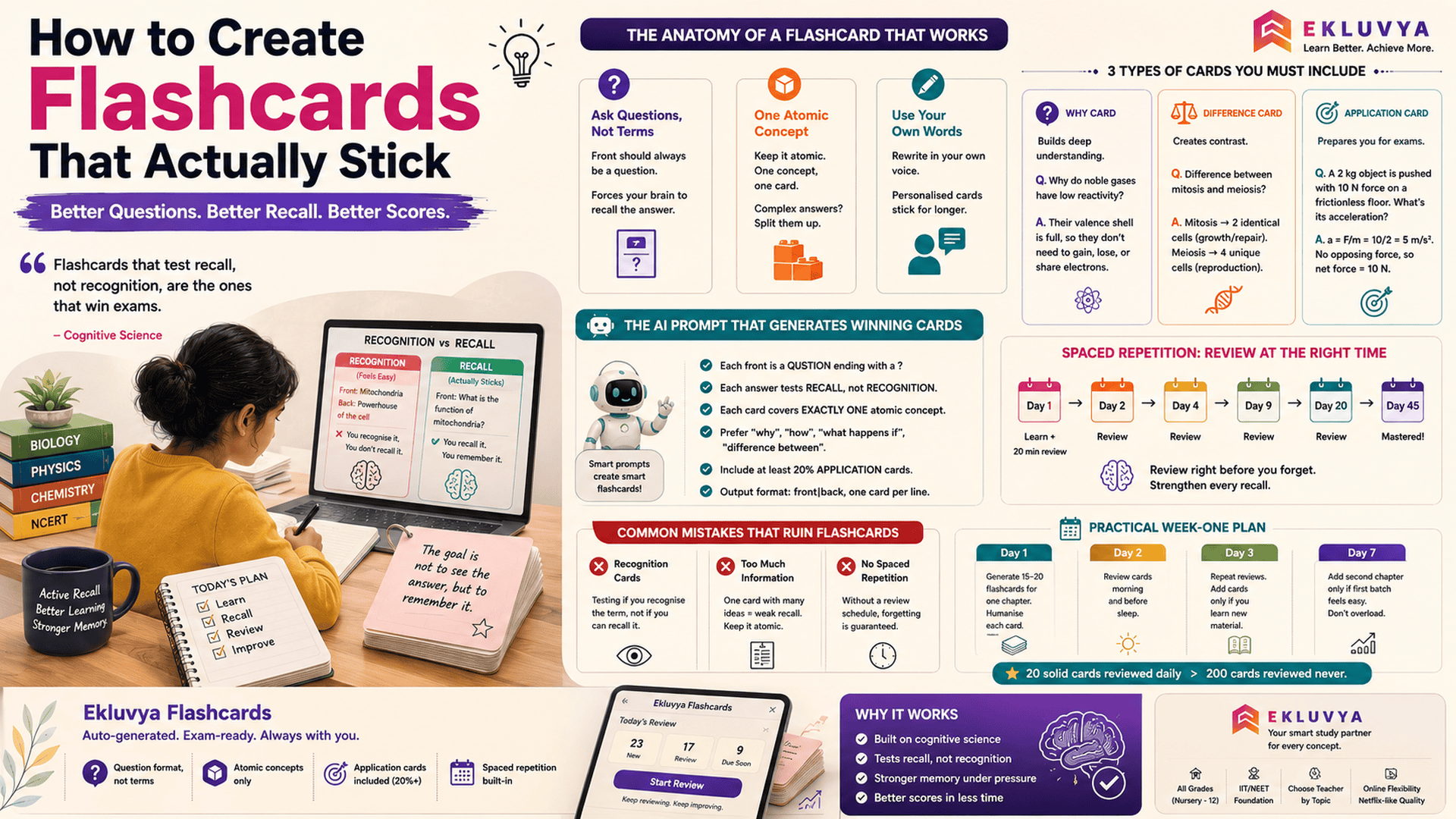
The anatomy of a flashcard that works
A good flashcard has three properties. Miss any one of them and you've got a card that feels useful but isn't.
Property 1: It asks a question, not defines a term
Every flashcard should have a question mark on the front. This is the rule most students break.
- ❌ Front: "Photosynthesis" / Back: "The process by which plants make food"
- ✅ Front: "What is photosynthesis, in one sentence?" / Back: "How plants use sunlight, water, and CO₂ to make glucose and oxygen."
The first one tests whether you recognise a word. The second one tests whether you can produce a definition. Only the second is exam-ready.
Property 2: It has exactly one atomic concept
If the answer has three bullet points, you've got three flashcards pretending to be one. Break them up.
- ❌ Front: "Describe the light-dependent reaction" / Back: [5-line paragraph]
- ✅ Three cards: "Where does the light-dependent reaction happen?" · "What does it produce?" · "What gets split in the process?"
Atomic cards are harder to write and 10× more effective to review. This is called the minimum information principle and it's one of the few things serious flashcard researchers all agree on.
Property 3: It's written in your own words
If the card sounds like it came from a textbook, it won't stick. If it sounds like you - with your phrasing, your examples, your weird little asides - it sticks like glue. Always rewrite AI-generated cards in your own voice before you save them.
The prompt that generates good flashcards
Here's the prompt I give students. It works with ChatGPT, Claude, Gemini, or the Ekluvyatutor inside Ekluvya. Paste your source material (a page of notes, a textbook section, a video transcript) and this prompt:
< class="code-block">From the material below, generate flashcards using these rules: 1. Each front is a QUESTION ending with a question mark. 2. Each answer tests RECALL (can I produce it from memory?), not RECOGNITION (do I recognise this word?). 3. Each card covers EXACTLY ONE atomic concept. If an answer has more than one idea, split into multiple cards. 4. Avoid "define X" style cards. Prefer "why", "how", "what happens if", "what is the difference between". 5. Include at least 20% "application" cards - questions that ask me to apply the concept to a new situation. 6. Output format: front|back, one card per line.The last rule - the 20% application cards - is the one that separates flashcards that get you through chapter tests from flashcards that get you through JEE. Rote recall isn't enough past a certain level. You need cards that ask you to use the idea.
Three types of cards you should always include
1. The "why" card
Never just ask "what is X?" Also ask "why is X the way it is?" This is the card that reveals real understanding.
- Front: Why do noble gases have almost no chemical reactivity?
- Back: Their outermost electron shell is already full, so they don't need to gain, lose, or share electrons to stabilise.
2. The "difference between" card
Your brain stores ideas through contrast. For any concept you learn, find its nearest neighbour and make a comparison card.
- Front: What's the key difference between mitosis and meiosis?
- Back: Mitosis produces 2 identical cells (for growth/repair). Meiosis produces 4 genetically unique cells (for reproduction).
3. The "application" card
The exam will not ask you to recite definitions. It will ask you to apply them to a situation you haven't seen before. Practice that skill on your flashcards.
- Front: A 2 kg object is pushed across a frictionless floor with 10N of force. What's its acceleration, and why?
- Back: 5 m/s². Because F = ma, so a = F/m = 10/2 = 5. Frictionless floor means no opposing force, so the net force equals the applied force.
Flashcards per subtopic, with spaced repetition built in
Every Ekluvya lesson comes with auto-generated flashcards that follow all three rules - question format, atomic concepts, application cards. They're reviewed on a spaced schedule so you see each card just before you'd forget it. No extra apps, no manual entry.
Try it free for 7 days →The spaced repetition part - non-negotiable
Good flashcards are half the job. Reviewing them on the right schedule is the other half. Your brain forgets exponentially - you lose ~50% of new information within an hour if you don't reinforce it. Spaced repetition is the practice of reviewing cards right before you forget them, which strengthens the memory maximally.
The simplest schedule that works:
- Day 1: Learn the card. Review once after 20 minutes.
- Day 2: Review again.
- Day 4: Review again.
- Day 9: Review again.
- Day 20: Review again.
- Day 45: You probably know it for good.
You can do this manually with index cards and a calendar. Or use an app like Anki. Or - and this is what most Ekluvya students do - use a platform that handles the scheduling for you while you just show up and review.
A practical week-one plan
If you're starting from zero tonight:
- Day 1: Pick ONE chapter from ONE subject you're struggling with. Generate 15–20 flashcards using the prompt above. Humanise each one.
- Day 2: Review those cards for 10 minutes in the morning, 10 minutes before sleep.
- Day 3: Same. Add cards only if you learn new material.
- Day 7: If your 20 cards feel easy, add a second chapter. If not, keep grinding - don't add more.
The discipline is not to add too much. 20 solid cards reviewed daily beat 200 cards reviewed never.
What flashcards can't do
Flashcards are for atomic facts and concepts. They are not for:
- Long derivations (use worked examples instead)
- Problem-solving strategies (use actual practice problems)
- Essay writing (use outlines and rewrites)
Use the right tool for the right part of the job. Flashcards are superb for the 70% of every subject that is definitional and conceptual. For the remaining 30%, you'll need different methods. That's what the rest of this blog is for.
Open a New Door with Ekluvya by which your child gets:
- All grades (Nursery - 12) and IIT/NEET foundation courses
- The power to choose a teacher, by topic
- Online flexibility and Netflix-like quality