
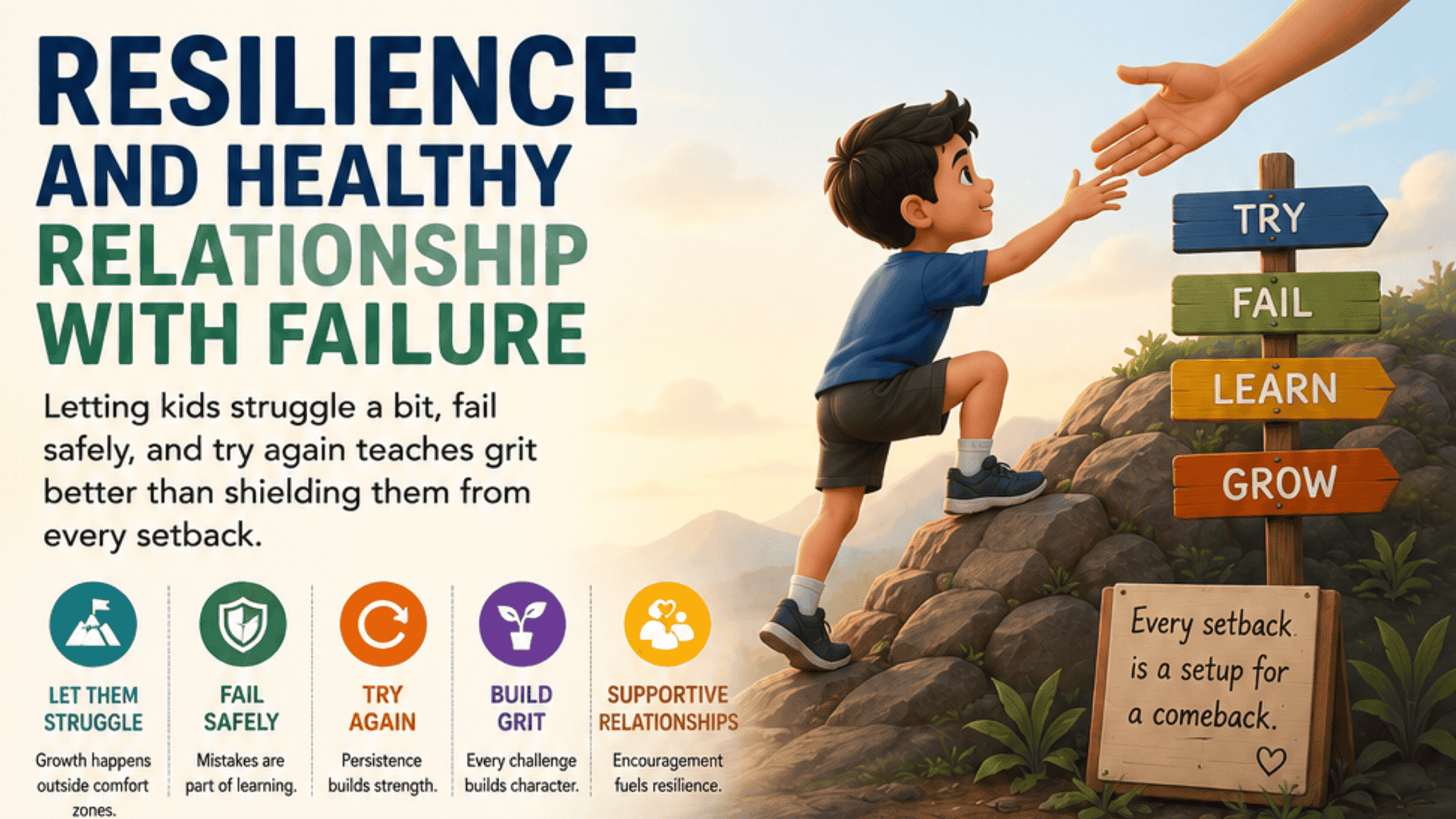
Introduction
No parent wants to watch their kid struggle. But the instinct to swoop in at the first sign of difficulty quietly teaches a different lesson than the one we intend — that struggle means something is wrong, and someone else should fix it. Here's how to build a healthier relationship with failure, one small setback at a time.
1. Let Them Struggle a Little
Struggle isn't a sign that something has gone wrong — it's usually the moment actual learning is happening. Rescuing a child too quickly skips that part entirely.
- Pause before helping — count to ten and see if they find their own way through.
- Ask "What have you tried so far?" before offering a solution.
- Let small setbacks stay small: a lost game, a wrong answer, a wobbly block tower.
The goal: Build tolerance for discomfort before jumping in with a fix.
2. Treat Failure as Data, Not Identity
"I failed at this" and "I am a failure" are very different sentences — but kids often can't tell them apart unless the adults around them draw the line clearly.
Identity language: "You're so bad at this."
Data language: "That approach didn't work — what's another one?"
Try a nightly "best mistake" check-in — what went wrong today, and what did it teach you?
3. Model Your Own Setbacks
Kids learn how to handle failure mostly by watching it happen, not by being told how to handle it. Narrating your own mistakes out loud is one of the most effective tools available.
Helpful modeling: "I burned dinner — let's see what we can salvage and try a lower heat next time."
Unhelpful modeling: Hiding mistakes, reacting with visible shame, or never letting kids see you try something new.
4. Praise the Effort, Not Just the Outcome
Praising innate talent ("you're so smart") can make kids fear the next challenge that might prove it wrong. Praising effort and strategy keeps them willing to try.
Effort → Strategy → Improvement
This shift — from praising fixed traits to praising process — is the core of what psychologists call a growth mindset, and it's learnable at any age.
Key Takeaways
- Pause before rescuing — struggle is often where the learning happens.
- Separate the mistake from the person: "that didn't work," not "you're bad at this."
- Narrate your own setbacks out loud so kids see recovery modeled, not hidden.
- Praise effort and strategy over fixed traits like "smart" or "talented."
- Small, safe failures now build the tolerance for bigger ones later.
The Bigger Idea
Resilience isn't built by avoiding every setback — it's built by surviving small ones, safely, often enough to trust that failure isn't the end of the story.
Your Turn
What's one small way you could let your child struggle safely this week — before stepping in to fix it?
Open a New Door with Ekluvya by which your child gets:
- All grades (Nursery - 12) and IIT/NEET foundation courses
- The power to choose a teacher, by topic
- Online flexibility and Netflix-like quality